

This post contains affiliate links. If you sign up through them, I may earn a small commission at no extra cost to you.
Introduction: The Easiest Way to Add More Automation to Your ClickUp Workspace
ClickUp has been rolling out powerful AI features. One of the easiest, most impactful updates is the introduction of AI Custom Fields.
If you’ve ever wished ClickUp could:
- read your task content and categorize it for you
- instantly read months of comments and info in a task and give a bulleted summary
- or run a prompt with info from your task
…this is the feature that makes it happen.
As a Verified ClickUp Consultant, I’ve tested this extensively across real client workspaces, and the results are consistently impressive. With the right prompt and setup, AI custom fields can eliminate hours of manual work, reduce human error, and help you to get things done faster and more efficiently.
Let’s walk through how they work and how to use them strategically.
What Are ClickUp AI Custom Fields?
AI custom fields use ClickUp’s built-in artificial intelligence to generate any information about your task based on your prompt unlike traditional custom fields which just store data. Note to check your plan details to be sure about what AI features are available.
They scan information from:
- task titles
- descriptions
- comments
- updates
- custom fields
- assigned users
- dates
and generate information for you. You can use AI custom fields in Dropdown Custom fields and Long Text Area fields.
Key Benefits of Using AI Custom Fields
Automated task categorization
Tasks sort themselves with no human interaction required. For example, ClickUp’s AI analyzes the information in a task and determines whether the task is on track or off track.
Reduced human error
No more incorrect or missing categories. Let AI do the work for you and ensure the field is filled in every time.
Cleaner data for dashboards + reporting
Consistent categorization = more accurate views, filters, and automations. When AI does the categorization, there are no human errors or influence in the decision making.
Real-time updates when task content changes
If you update a task, AI can re-run the categorization automatically with this setting turned on.
Less admin for you or your team
This is especially helpful for teams who benefit from reduced manual steps and clearer, automated systems.
How to Create Your First AI Dropdown in ClickUp
Here’s the step-by-step process:
- Navigate to your List
- Click + to add a new column
- Choose Dropdown
- Add your options
- Turn AI Autofill on
- Write your AI prompt (the most important step!) to automatically assign dropdown values or choose one of the prebuilt options
- Optionally turn on the options to auto update when tasks change and autofill existing tasks
- Save and test
- Refine as needed
Pro Tip
Start simple. Categorizations with 2–3 clear options work best when you’re learning how ClickUp AI interprets data.
How to Create Your First AI Autofill Text Field in ClickUp
- Navigate to your List
- Click + to add a new column
- Choose AI Autofill and name the field
- Enter your custom prompt or choose one of the prebuilt options
- Optionally turn on the options to auto update when tasks change and autofill existing tasks
- Save and test
- Refine as needed
Real-World Example: Budget Categorization
Imagine you manage recurring projects and want to quickly identify which tasks include budget details.
Step 1: Create two dropdown options
- Budget Specified (Green)
- No Budget Info (Red)
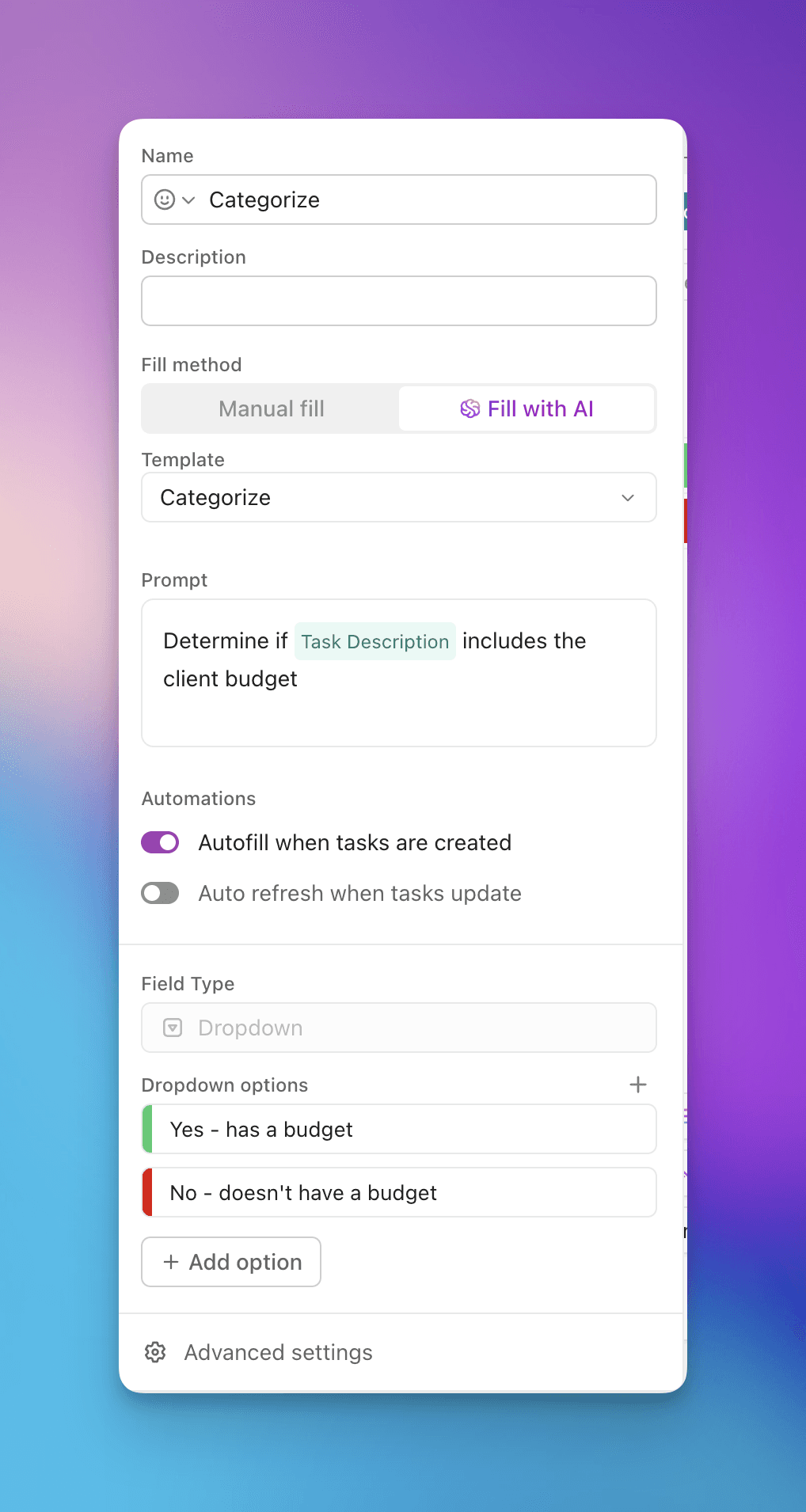
Step 2: Use an AI prompt like:
“Review the task title and description. Select ‘Budget Specified’ if any dollar amount, cost estimate, or pricing details are mentioned. If not, select ‘No Budget Info.’”
Step 3: Run the AI Categorization
Click the Brain icon to update the field automatically.
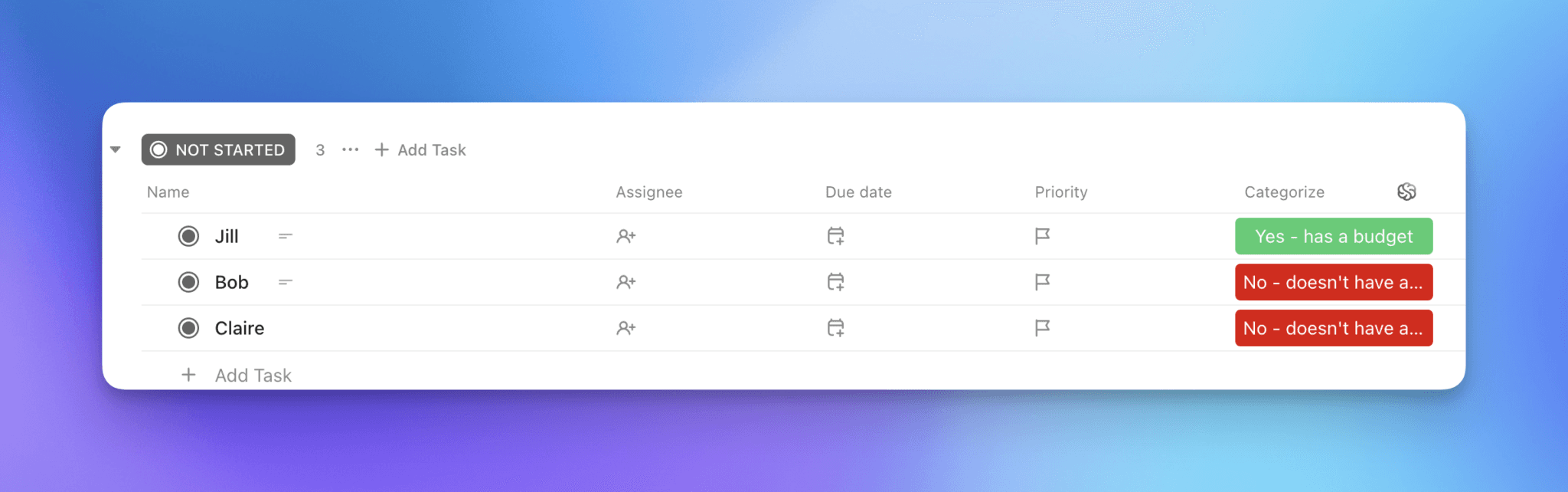
This is great for:
- content teams
- operations managers
- service providers
- project managers
- client delivery teams
It reduces manual checking and makes it easier to surface missing information.
Real-World Example: Client Update Summary
Create a “client update” AI text field with the prompt “summarize the latest comments into 3 bullets for the client”.
Advanced Use Cases: What AI Dropdowns Can Analyze
AI dropdowns can look at almost any part of a task:
- Task description
- Comments or updates
- Custom fields
- Assigned users
- Due dates
- Priorities
- Subtasks
- File names
- Tags
This makes them extremely flexible.
Some powerful examples:
Client Workflows: Categorize tasks by service type or deliverable type.
Content Production: Sort drafts by topic, format, or funnel stage.
Sales Pipelines: Flag whether leads include key information.
Internal Operations: Tag tasks as admin, marketing, ops, or finance based on wording.
Project Health: Have AI categorize tasks as “Clear,” “Needs Info,” or “Blocked.”
Combine AI Fields with Automations
Set up an automation to refresh an AI field or do anything with AI after a certain trigger. For example, fill in an AI generated greeting for an email after contact information is filled in. You’d set up the automation like this:
- Whenever the Contact Name field is filled in, refresh the AI field “greeting” which has a prompt with how to write the greeting.
Combine AI Fields with AI Agents for even more power
Have your AI agent do research on a company and then update the AI custom field “lead quality” to strong, medium, or poor based on if it’s a good fit for you or not. This alone has saved me hours of manual work.
Best Practices: How to Write High-Accuracy Prompts
The quality of your AI dropdown results depends on the clarity of your prompt.
Here’s what works best:
- Be specific about what the AI should look for – mention keywords, patterns, or types of information.
- Use unambiguous language – avoid fuzzy terms like “look for anything important.”
- Provide clear differentiation between dropdown options – the AI performs best when options are highly distinct.
- Test multiple tasks – run categorizations across several tasks to see patterns.
- Refine over time – your processes will evolve. Update prompts as needed.
Common Mistakes to Avoid
These are the most frequent issues I see when teams begin using AI dropdowns:
Creating too many dropdown categories
AI performs better with fewer, clearer distinctions.
Assuming AI will always be perfect
You still need periodic reviews, especially early on.
Using vague prompts
The AI can’t read your mind. Tell it exactly what to look for.
Never updating prompts
Your workflows change. Your AI instructions should too.
Relying on messy or incomplete task descriptions
AI can only analyze what’s there — clean inputs = clean outputs.
How to Measure Success (and ROI)
Want to prove the value of AI custom fields? Track:
- Time saved from manual categorization: even 2–3 seconds per task adds up to hours each year.
- Accuracy rate: how often the AI gets the categorization correct.
- Team adoption: are people using the feature consistently?
- Workflow improvements: do views, reports, or dashboards load cleaner data?
- Reduced errors: fewer mis-categorized tasks = smoother operations.
Conclusion: AI Custom Fields Are a Small Change With a Massive Impact
ClickUp AI custom fields might look like a minor feature, but they unlock a huge amount of automation potential across your workspace.
They help you:
- eliminate repetitive admin
- reduce human error
- keep data consistent
- improve visibility
- speed up reporting
- generate task updates in seconds
- and create cleaner, more scalable systems
Start small, learn how AI interprets your data, and you’ll quickly find dozens of ways to expand this automation across your workflows.
Next Steps
Here’s how to get started:
- Identify one repetitive categorization task your team does manually
- Create your first AI custom field
- Test it across several tasks
- Gather feedback from your team
- Expand into more areas of your workflow
And if you want support implementing AI-powered systems in ClickUp that save time, improve accuracy, and support real growth…
👉 Book a ClickUp Setup or Optimization Consultation with New Leaf Digital
I can help you turn ClickUp into the intelligent, streamlined operating system your business deserves.